
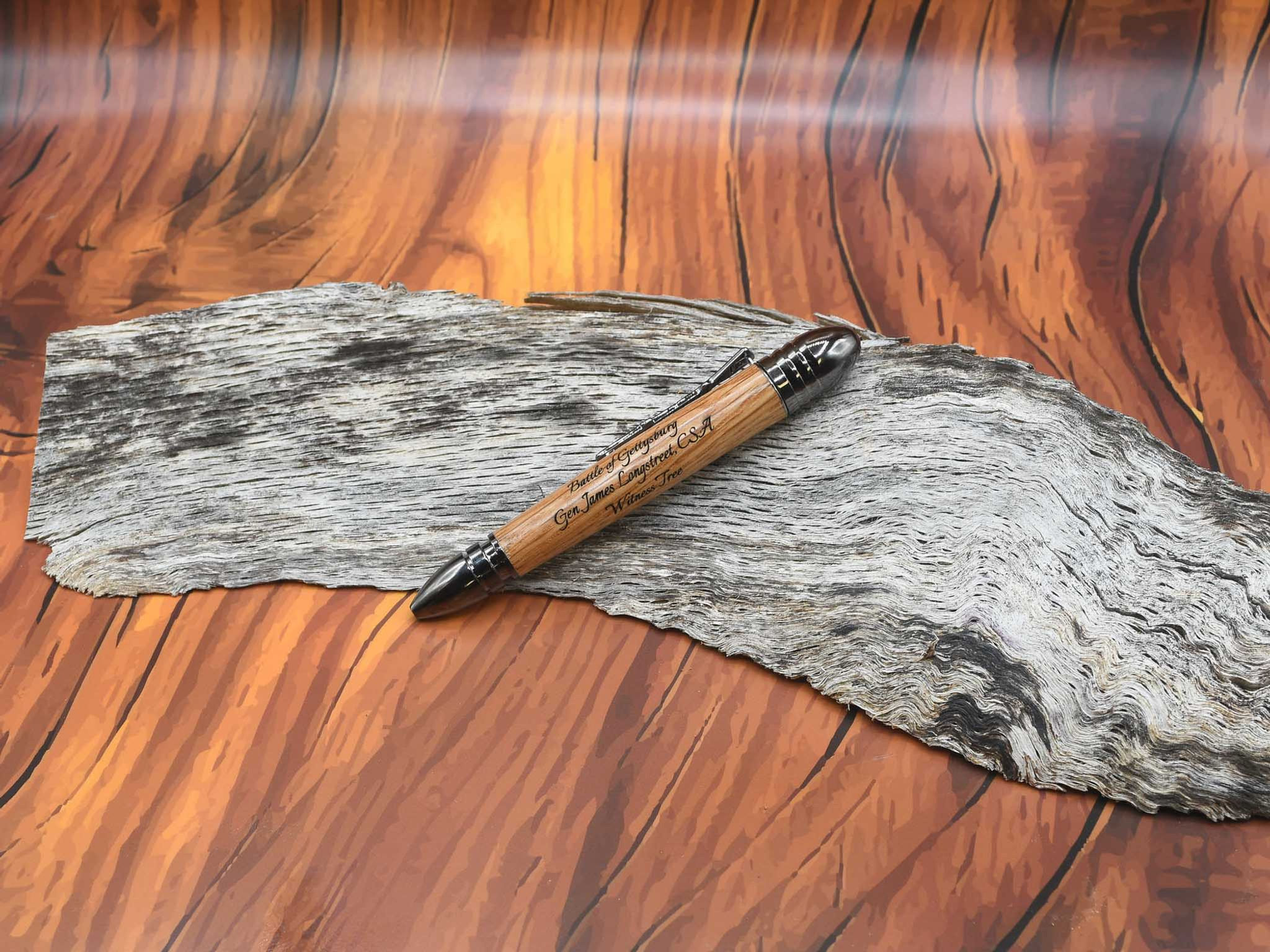

General James Longstreet, CSA, Oak Witness Tree Civil War Pen
The cap of this very unique pen is a replica 58 Caliber Minnie Ball, the most commonly used bullet in the Civil War. Adopted by Americans in 1855, rings were added to the original French design. It was used in the Model 1861 Springfield Rifle Musket. The tip is a replica of the 44 caliber 1860 Colt Army Revolver Bullet. The revolver was the favorite side arm for cavalry, infantry and artillery troops. The clip is a detailed replica of the 1861 Springfield Rifle. Reveal the pen tip by rotating the cap.
The History Behind This Collection
Born January 8, 1821, James Longstreet was one of the foremost generals for the Confederate States of America during the American Civil War and a principal subordinate to Gen. Robert E. Lee, who called him his "Old War Horse." Longstreet served under Lee as a corps commander for most of the battles fought by the Army of Northern Virginia in the Eastern Theater and briefly with Braxton Bragg in the Army of Tennessee in the Western Theater.
After graduating from the U.S. Military Academy at West Point, Longstreet served in the U.S. Army during the Mexican American War. He was wounded at the Battle of Chapultepec and, during recovery, married his first wife, Louise Garland. Throughout the 1850s, he served on frontier duty in the American Southwest. In June 1861, Longstreet resigned his U.S. Army commission and joined the Confederate Army. He commanded Confederate troops during an early victory at Blackburn's Ford in July and played a minor role at the First Battle of Bull Run.
Longstreet is perhaps best known for his role in the Battle of Gettysburg, particularly on July 2 and 3, 1863. Lee's plan for July 2 called for Longstreet to attack the Union's left flank, to be followed by Hill’s attack on Cemetery Ridge near the center, while Ewell demonstrated on the Union right. Longstreet argued for a flanking maneuver around the Union left, but Lee rejected his plan, opting for a frontal assault on Little Round Top. Longstreet’s commanders also opposed this strategy. They, along with Longstreet, understood that the Union held the better ground and the cost of taking their position would be very high. Nevertheless, Longstreet was obliged to follow Lee’s orders. Unfortunately, he was not ready to attack as early as Lee desired. Many brigades were still on their march in long columns to the west. Longstreet’s attack on Day 2 of the Battle of Gettysburg did not begin until 4 p.m. In the end, Day 2 of the Battle of Gettysburg was a stalemate, with staggering losses for the Army of Northern Virginia.
On Day 3, Lee ordered Longstreet to coordinate a massive assault on the center of the Union line at Cemetery Ridge with his corps. Longstreet strongly felt that this assault had little chance of success and shared his concerns. The assault would require a nearly one-mile march of open ground under fire. Lee did not change his mind, and Longstreet relented. The final plan called for an artillery barrage by 170 cannons. Then, nearly 15,000 troops would advance on the Union center.
Longstreet agonized over the assault. The artillery bombardment began at about 1 p.m. Union batteries responded, and the two sides fired back and forth for about an hour and 40 minutes. When the time came to order the troops forward, Longstreet could only nod in assent, unable to verbalize the order, thus beginning the assault known as Pickett's Charge. Beginning at about 3 p.m., Confederate troops marched toward the Union positions. As Longstreet had anticipated, the attack was a complete disaster. The assaulting units suffered massive casualties. Pickett's first two brigades were severely mauled. A small number of troops briefly breached the stone wall that marked Hancock's lines, but they were quickly repulsed. The Battle of Gettysburg would be a resounding Union victory.
To his men, Lee said, "It is all my fault." According to two of Longstreet's staff officers, Lee subsequently expressed regret for not taking Longstreet's advice. On July 4, the Confederate army began its retreat from Gettysburg. Hampered by rain, the bulk of the army finally made it across the Potomac River on the night of July 13–14.