
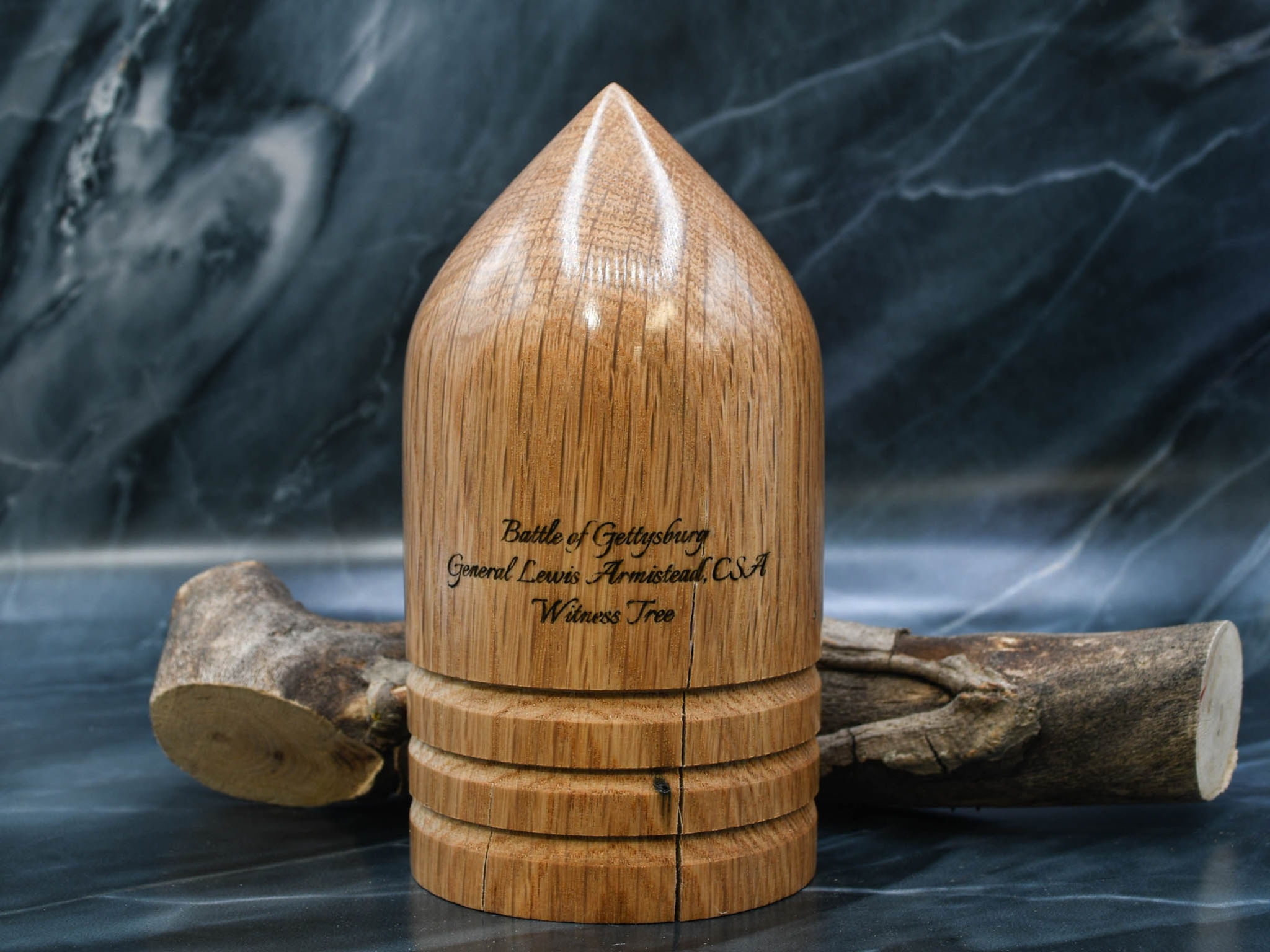

General Lewis Armistead, CSA, Oak Witness Tree Paperweight
Born in New Bern, North Carolina in 1817, Lewis Addison Armistead was of English descent whose ancestors emigrated to Virginia in the early 1600’s. A tradition of military and political service became a part of his lineage. Young Armistead attended but did not graduate from the United States Military Academy at West Point citing academic deficiencies. However, his influential father secured a commission for Armistead as a second lieutenant in the 6th United States Infantry in 1839.
Armistead began his military service in the Oklahoma territory and later served in the Mexican War and was eventually promoted to brevet major. The 1850’s would find Armistead serving throughout the West in the Indian Wars and ultimately in command of a garrison in San Diego in 1860 when the Civil War broke out. It was in California that his strong friendship with Winfield Scott Hancock developed. The Civil War would place the two friends on opposite sides of the conflict as their allegiance to their home states determined their paths in the conflict.
Armistead was quickly promoted to colonel of the 57th Virginia Infantry Regiment in the western part of Virginia. Later, he served the Army of Northern Virginia as a brigade commander at Seven Pines and led the bloody assaults on Malvern Hill and Second Bull Run. Ultimately, he became part of Major General George Pickett’s division by the time the Army of Northern Virginia began the Gettysburg Campaign.
Brigadier General Lewis Armistead’s brigade arrived at the Battle of Gettysburg late on July 2nd after a lengthy march from Chambersburg, PA. Late on the afternoon of the next day, July 3rd, after a Confederate cannonade of two hours, Armistead led his brigade in an assault that became known as Pickett’s Charge. Leading his brigade across a mile of open terrain and part of an assault of over 12,000 infantry, their goal was to break the center of the Union line on Cemetery Ridge. Armistead knew his good friend Hancock was likely defending the position he was about to attack. Union troops mostly held their fire until the Confederates were within a few hundred yards when they let loose with canister and rifle fire. The Confederate lines were quickly decimated. As Armistead’s dwindling brigade neared the Union position near the center he placed his hat on his sword and waved it bravely for his men to follow. Armistead and a handful of his troops were the only troops to breach the Union position, but they were quickly subdued. Armistead was mortally wounded and taken to Spangler Farm Field Hospital where he died on July 5th. Prior to his death he asked for his good friend Hancock but learned that he too was wounded. The two friends were never reunited.
The position on the battlefield reached by Armistead on July 3rd, 1863, became known as the High-Water Mark of the Confederacy. Lewis Armistead is buried next to his uncle, Lieutenant Colonel George Armistead, commander of the garrison of Fort McHenry during the Battle of Baltimore, at the Old Saint Paul's Cemetery in Baltimore, Maryland.